
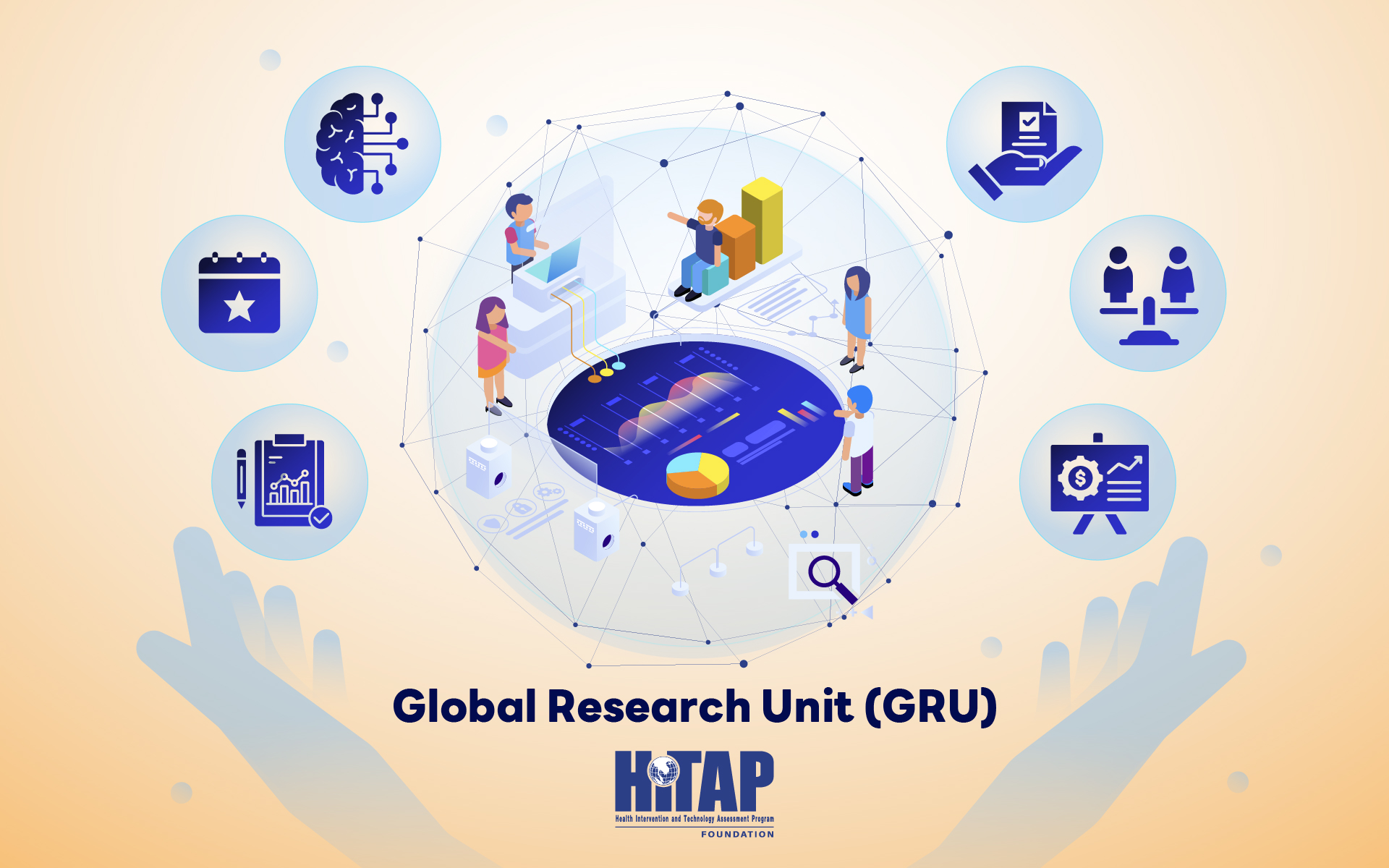


The Health Intervention and Technology Assessment Program Foundation (HITAP) establishes the Global Research Unit (GRU), a new team created to strengthen evidence-informed policymaking in Thailand and internationally.
Why GRU Matters
Health technology assessment (HTA) has expanded far beyond its traditional role in guiding medicine reimbursement decisions. Today, governments turn to HTA agencies for advice on health service delivery, system design, health promotion, and even policies with cross-sectoral impact.
HITAP establishes GRU to help meet these needs by identifying policy questions that standard HTA cannot fully address and designing or adapting methods that provide timely, practical insights. “Our aim is to strengthen policymaking by developing practical guidance and tools that fit different contexts. We focus on approaches that are rigorous but feasible to implement, especially in low- and middle-income countries (LMICs),” says Ms. Siobhan Botwright, Head of GRU.

A Team Built on Expertise and Collaboration
GRU is a growing team of experts from diverse fields, such as health economics, health systems research, epidemiology, monitoring and evaluation, health promotion, and qualitative research, working together to develop solutions for real policy needs. The team works closely with other HITAP teams and both national and international partners to ensure its work is suitable to diverse contexts.
In doing so, the team helps ensure that health policies are not only evidence-informed, but also implementable and impactful. GRU also reflects HITAP’s broader commitment: advancing innovation, building strong collaborations, and delivering solutions that matter for health systems.
How GRU is Driving Change
GRU has begun contributing to key initiatives in health policy, including:
- Integrating Systems Thinking with HTA:
Systems thinking helps explain why policies sometimes fall short of their intended impact. GRU applied this approach to develop a system dynamics model that shaped Thailand’s 2024 kidney replacement therapy policy, as detailed in a recent published article. It is now being used in projects on caesarean sections, maternal and child health programs for migrants, HTA system evaluation, and the mid-term review of National Strategic Plan on Antimicrobial Resistance (NSP-AMR) in Thailand. The team is also drafting a chapter on systems thinking for Thailand’s HTA guidelines, aiming to promote good practices in the long term.
- Structured Expert Elicitation:
When data is unavailable, limited, or difficult to collect within a short timeframe, policymakers often rely on expert opinion. GRU developed a guide on the Delphi method to ensure expert input is of high quality while considering time and resource limits, and is conducting training for its use across HITAP projects.
- Expanding Economic Evaluation for Kidney Replacement Therapy Policy:
In many LMICS, kidney replacement therapy policies are developed without economic evaluation or with a narrow focus on comparing technologies. GRU, with international experts, created guidelines showing how economic evaluation can inform a wider range of policy questions and be adapted to local context, research capacity, and available resources. The full article, “Guidelines for the Use of Economic Evaluation to Inform Policies around Access to Treatment for Kidney Failure”, is available here.
Focus for the Road Ahead
“Our overarching vision is to empower national, regional and international policymakers and stakeholders with innovative, rigorous, and contextually relevant HTA insights to support decision making in health policy,” adds Ms. Botwright. With this vision, GRU aims to ensure that policies are effective, equitable, and evidence-informed.
Currently, the team is working on the following priority areas:
- Systems Thinking: Understanding how health policies interact with different parts of the health system and other sectors
- Antimicrobial Resistance: Developing methods for evaluating antimicrobial resistance policies in low- and middle- income countries
- HTA System Evaluation: Tailoring evaluations to local goals and contexts beyond benchmarking
- Implementation Science: Bridging the gap between policy adoption and sustainable practice change
- Equity: Expanding tools to integrate fairness and inclusion into the policymaking process
- New Approach for Economic Evaluation: Applying innovative methods to address broader policy questions
Join This Journey
GRU warmly welcomes collaboration with HTA agencies, researchers, and partners, both in Thailand and internationally. “If your work aligns with any of our focus areas, we would be delighted to explore how we can create real policy impact together,” says Ms. Botwright.
For collaboration inquiries, contact us at [email protected].

![[ข่าวประชาสัมพันธ์] ขอเชิญเข้าร่วมการประชุมการประชุมเชิงปฏิบัติการ หัวข้อ “การวิจัยไม่สูญเปล่า: พัฒนานวัตกรรมสุขภาพอย่างไรให้คุ้มค่า”](https://www.hitap.net/wp-content/uploads/2025/07/MIDAS_Banner_1000x764.jpg)