

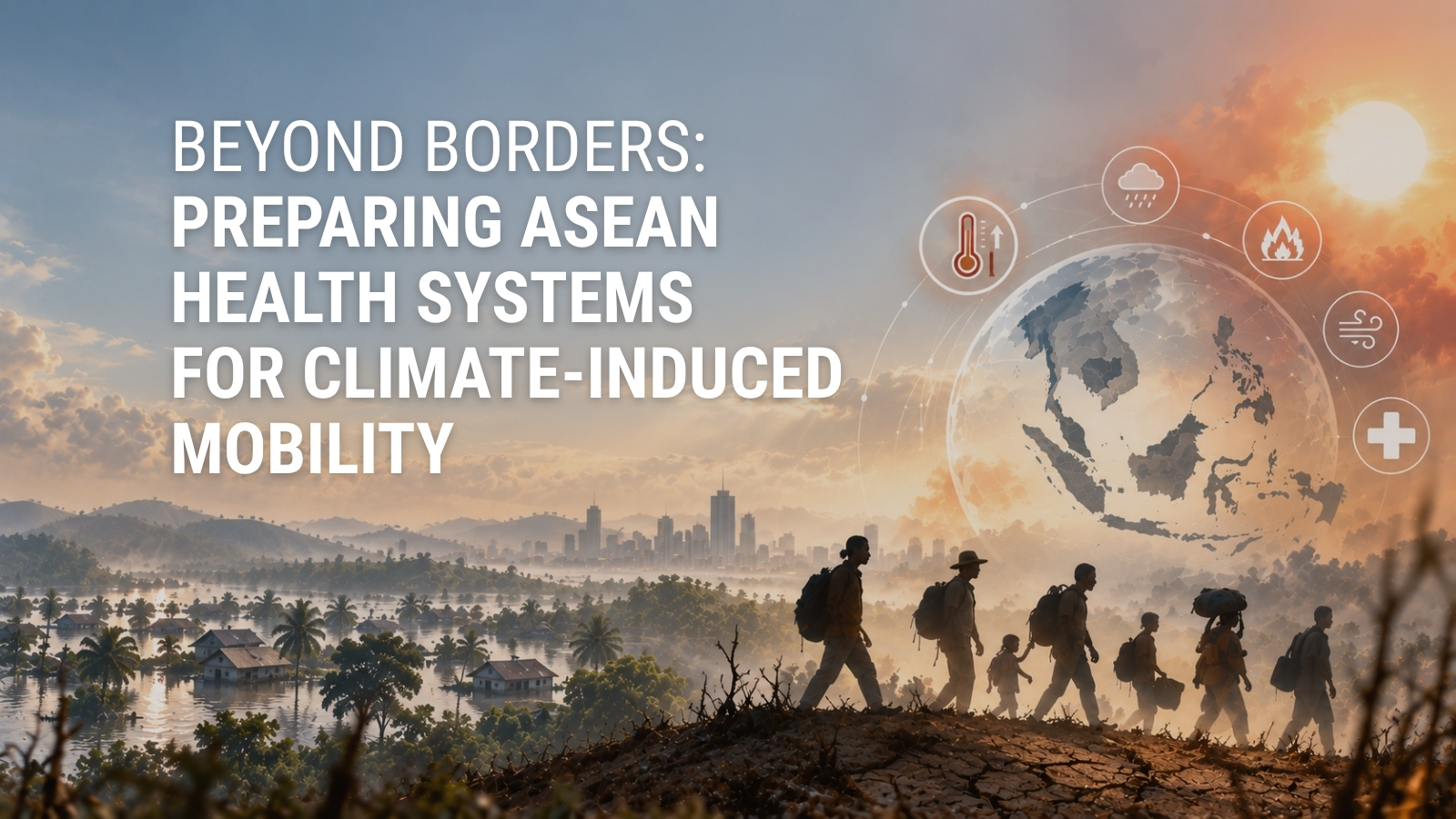
When floods, haze, and heatwaves force people from their homes, their health needs do not stay behind — but the systems meant to care for them are built for people who stay put. This piece looks at why climate-driven mobility is becoming a health systems challenge for Southeast Asia, what ASEAN is already doing about it, and where the gaps still are.
A Region Under Mounting Climate Pressure
Southeast Asia is experiencing rising exposure to floods, extreme heat, landslides, forest fires, and other environmental pressures that affect health and livelihoods across the region [1]. In late 2025, intense monsoon rains and successive cyclones triggered severe flooding across Thailand, Indonesia, and Malaysia. The flooding in southern Thailand alone killed at least 145 people and displaced roughly 2 million, while Indonesia recorded around 700 deaths and 570,000 displaced [2]. As of August 2026, Indonesia’s wildfire season has again driven transboundary haze into Malaysia, pushing air quality in Sarawak to “very unhealthy” levels and prompting indefinite school closures in Sarawak and West Kalimantan [3]. Regional forecasters have rated 2026 a “Red” (high) risk year for severe haze, only the second such rating issued since 2019, citing El Niño conditions and a possible Indian Ocean Dipole that could prolong the dry season [4]. This recurring haze has been linked to respiratory, cardiovascular, and other acute health effects, particularly among children and older adults [5].
When People Move, Health Needs to Move Too
Beyond their direct health toll, these hazards are also changing how people live and move. For some, these events cause temporary disruption; for others, they reshape where and how people live, work, and access health care through temporary displacement, rural-to-urban movement, planned relocation, or movement across borders [6]. In Southeast Asia, where the region is highly connected, these dynamics carry special significance. People move across borders for work, family, safety, education, and survival. At the same time, many climate risks do not respect borders. Haze, heat, floods, storms, and disease risks can affect neighbouring countries and mobile populations in different ways. [7]. However, current health systems and insurance schemes are mainly designed for stationary populations.
This raises a simple but important question: What if health coverage and social protection entitlements were designed to be inclusive of migrant populations?
A Gap in How Systems are Built
The question tries to understand how health systems can better respond when people’s lives and care needs move across places. When someone is displaced, working across a border, or living outside their usual place of registration, their health needs do not pause. But access to care, insurance coverage, medical records, social protection, and public health surveillance are often still tied to fixed locations, citizenship status, or formal documentation [8].
This is where climate-related mobility becomes a health systems issue, not only a disaster, labour, or border issue. A more prepared region may need practical mechanisms such as:
- Cross-border referral pathways
- Better health information sharing
- Migrant-inclusive continuity of care
- Emergency access arrangements
- Financial protection for essential services
- stronger surveillance for climate-sensitive health risks
Unlike refugees and asylum-seekers, people moving because of climate impacts have no recognised status under international law. That leaves them in a grey zone, often uninsured, often ineligible, and easy to miss in national planning. World Health Organization (WHO) has also called attention to the need for migrant-inclusive and climate-resilient health systems, including systems that respond to the needs of displaced and migrant populations as well as host communities [8].
What ASEAN is Already Doing
Southeast Asia is not starting from zero. The Association of Southeast Asian Nations (ASEAN) Agreement on Disaster Management and Emergency Response already provides a legally binding basis for regional cooperation in reducing disaster losses and strengthening joint emergency response [9]. ASEAN has also developed programs on health coverage for documented migrants, including migrant workers and special populations, with attention to health governance, service delivery, financing, and health information systems [10]. These are important starting points, however, the climate–migration–health connection still needs to be brought together more clearly, especially on practical interventions such as financing arrangements, emergency access to care, and cross-border coordination that could support affected communities during climate-related shocks.
Our Project
Evidence on climate, migration, and health is growing, but it is often siloed across different fields: climate change, migration, disaster risk reduction, occupational health, public health, social protection, and health financing. Our project aims to bring these strands together to identify the key health risks, policy gaps, and priority questions that Southeast Asian countries need to address in responding to climate-related mobility. Building on discussions linked to the Prince Mahidol Award Conference (PMAC) 2026, our project focuses on setting the agenda for ASEAN responses to the health risks associated with climate-related mobility. PMAC 2026 brought migration, labour, climate, and health into the same conversation, including issues such as health coverage cross-border migrants, occupational and environmental health risks, and the integration of migration and displacement into climate adaptation discussions [7].
Beyond Movement — Are Systems Ready?
Climate-related mobility is not only about people moving. It is also about whether systems are ready when they do. For Southeast Asia, the challenge is to think beyond borders, and to ask how health systems, financing arrangements, and regional cooperation can better protect people whose lives and care needs are increasingly shaped by climate risk [2,3]. To address this, we are conducting a scoping review to support agenda-setting in ASEAN and better understand the current challenges and gaps, particularly in relation to health financing. Stay tuned to hear more about the project and visit our project page here for updates.
-
SEA DREAM [Internet]. [cited 2026 Aug 26]. Climate Change in Southeast Asia | SEA DREAM Feature. Available from: https://sea-dream.org/newsandevents/climate-change</p?
-
Asia Floods of 2025: Sri Lanka, Indonesia, Thailand, Malaysia, the Philippines, Vietnam. – Google Search [Internet]. [cited 2026 Aug 26]. Available from: https://www.britannica.com/event/Asia-Floods-of-2025
-
Kwok Y. Indonesia’s wildfire season surges as haze spreads into Malaysia. Conservation news [Internet]. 2026 Aug 13 [cited 2026 Aug 26]. Available from: https://news.mongabay.com/2026/08/indonesias-wildfire-season-surges-as-haze-spreads-into-malaysia/
-
SIIA E. SIIA Haze Outlook 2026 Warns of High Risk of Severe Transboundary Haze Event. Singapore Institute of International Affairs [Internet]. 2026 Jun 24 [cited 2026 Aug 26]. Available from: https://siiaonline.org/siia-haze-outlook-2026-media-release/
-
Cheong KH, Ngiam NJ, Morgan GG, Pek PP, Tan BYQ, Lai JW, et al. Acute Health Impacts of the Southeast Asian Transboundary Haze Problem—A Review. Int J Environ Res Public Health. 2019 Sep 6;16(18):3286. doi:10.3390/ijerph16183286
-
Mosca DT, Martini M. The Climate–Migration–Health Nexus: A Multisectoral Framework for Action, with Case Insights from MENA. Trop Med Infect Dis. 2026 Mar 11;11(3):79. doi:10.3390/tropicalmed11030079
-
Migration data portal [Internet]. [cited 2026 Aug 26]. Migration data in South-eastern Asia. Available from: https://www.migrationdataportal.org/regional-data-overview/south-eastern-asia
-
Health system strengthening interventions to improve the health of displaced and migrant populations in the context of climate change [Internet]. [cited 2026 Aug 26]. Available from: https://www.who.int/publications/i/item/9789240112452
-
AADMER Work Programme 2026-2030. ASEAN Main Portal [Internet]. [cited 2026 Aug 26]. Available from: https://asean.org/book/aadmer-work-programme-2026-2030-2/
-
Migration and Health in ASEAN: Regional Case Studies. ASEAN Main Portal [Internet]. [cited 2026 Aug 26]. Available from: https://asean.org/book/migration-and-health-in-asean-regional-case-studies/
Disclaimer: In the writing of this blog, the author used ChatGPT and Claude AI to assist with language editing, including grammar, sentence structure, and readability. After using this tool, the author reviewed and edited the content as needed and takes full responsibility for the content.