

Non-communicable diseases (NCDs) are often called “silent killers”, but there is nothing silent about their impact. They remain one of the hardest public health battles to win. According to the World Health Organisation (WHO), they cause 43 million deaths worldwide and account for 75% of non-pandemic-related mortality [1]. As of 2021, NCDs in Thailand are responsible for around 74% of all deaths, or approximately 400,000 deaths each year [2]. If decades of health promotion, screening, and prevention have not been enough to reverse the trend, then how can we do things differently? As health systems look for more responsive ways to prevent disease, Artificial Intelligence (AI) has increasingly entered the conversation.
AI is no longer a distant promise of the future. It is already shaping how we work, communicate, learn, and even make decisions about our health [3]. It is often described as a gamechanger, a tool that can make health promotion and disease prevention more efficient, personalised, and responsive [4]. But as AI moves deeper into public health, one question becomes harder to ignore: are health systems ready to adopt it or will it add strain to a complex, resource-hungry system?
In public health, much of the work on NCD prevention, health promotion, and early management happens through primary healthcare. This is where people are screened, counselled, followed up, and supported before complications develop or disease progresses. Yet in many low- and middle-income countries, primary care teams often must do this with limited staff, expertise, and time, with fragmented information systems [5,6] . As a result, patient education may not be sufficiently tailored, follow-up may be inconsistent, and health promotion messages in some case may remain too broad to reflect people’s different risks, routines, cultures, and languages [7].
This is where AI starts to sound promising. Imagine a system that can support primary healthcare by reminding patients when they are due for follow-up, helping health workers communicate prevention messages, tailoring health promotion materials to different groups, or generating simple summaries from patient records to reduce administrative workload. In settings where primary care teams are often stretched, AI could potentially improve efficiency, strengthen patient education, and help limited workforce capacity go further [8]. But public health is rarely that simple. AI depends on the right foundations: reliable data, digital infrastructure, health worker capacity, patient trust, digital literacy, and workflows that can absorb new tools, among others [9]. Prediction does not automatically lead to better care, and personalised advice will not make a difference if people cannot access, understand, or act on it. Hence, the real test is not whether AI has potential, but whether health systems are ready to integrate it in ways that are feasible, useful, and sustainable.
Thailand provides a useful setting to explore these questions. The country has prioritised NCD prevention while also exploring ways to build an effective AI ecosystem that can enhance the economy and improve quality of life [10]. Together, these priorities create an important opportunity to explore how AI could support health promotion and disease prevention in practice. Thailand already has several prevention and health-promotion programs both at the government and community level. At the government level, these programs include national strategies, NCD Clinic Plus, and village health volunteer-supported health promotion. At the hospital and community level, examples include diabetes education and self-management programmes, prediabetes interventions, and structured follow-up services.
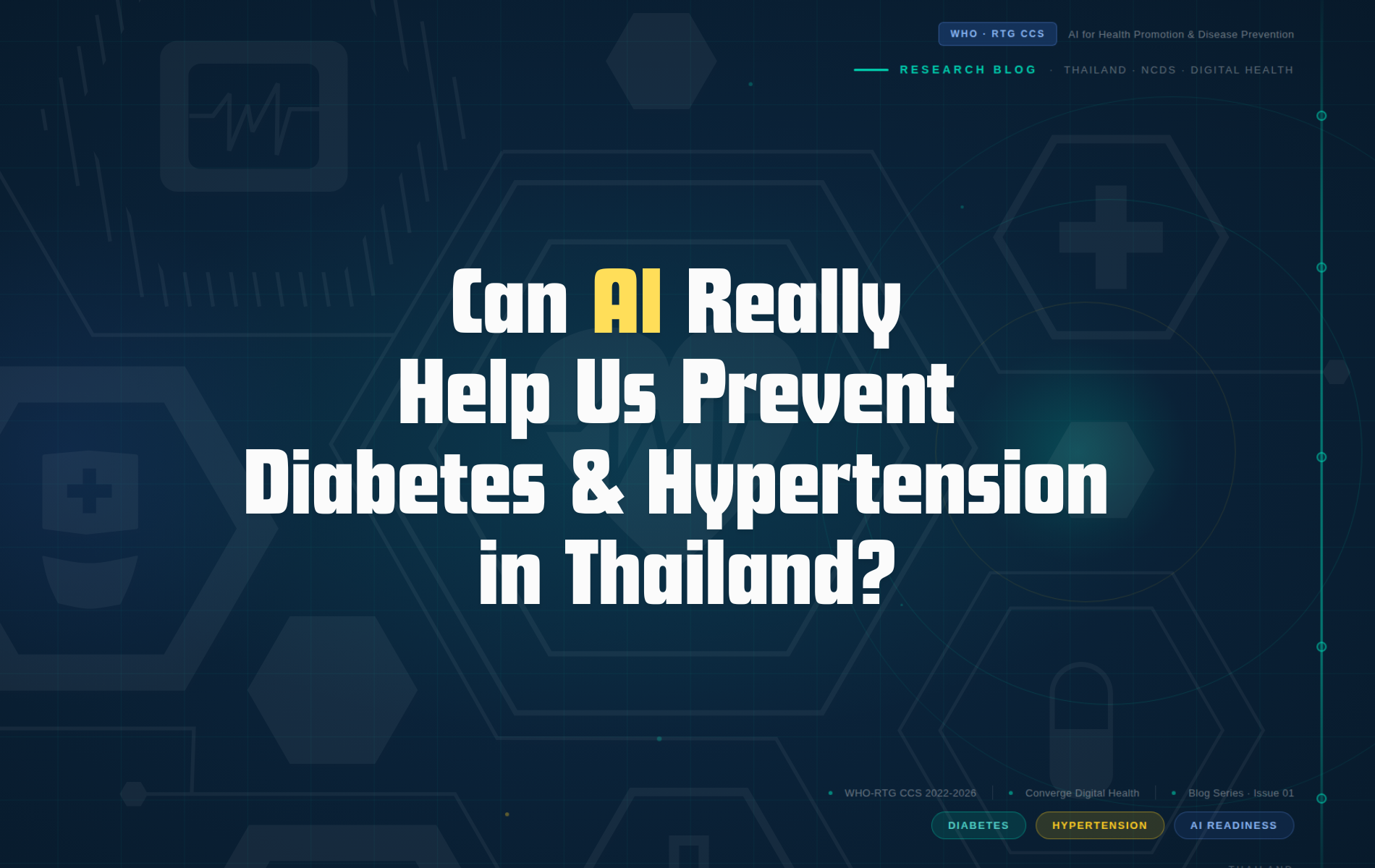
This project, under the Thailand WHO Country Cooperation Strategy (WHO-CCS) working group, will look beyond the general promise of AI to explore which AI tools could realistically be adopted within current NCD programmes in Thailand. With a specific focus on diabetes and hypertension, the project will identify where AI could address current barriers of programme implementation and what the Thai health system needs to adopt AI in a way that is sustainable and effective.
Stay tuned to hear more about our project!
References
-
World Health Organization. Noncommunicable diseases [Internet]. Geneva: WHO; 2025. Available from: https://www.who.int/news-room/fact-sheets/detail/noncommunicable-diseases
-
World Health Organization. Prevention and control of noncommunicable diseases in Thailand: the case for investment [Internet]. Bangkok: WHO Thailand.. Available from: https://www.who.int/thailand/activities/NCDs_Investment_Case_Report
-
Bajwa J, Munir U, Nori A, Williams B. Artificial intelligence in healthcare: transforming the practice of medicine. Future Healthc J. 2021 Jul;8(2):e188–e194. doi: 10.7861/fhj.2021-0095
-
Dugas M, Trottier MÈ, Bhatt M, et al. Artificial intelligence in health promotion and disease reduction: rapid review. J Med Internet Res. 2025;27:e70381. doi: 10.2196/70381
-
Kamvura TT, Dambi JM, Chiriseri E, Turner J, Verhey R, Chibanda D. Barriers to the provision of non-communicable disease care in Zimbabwe: a qualitative study of primary health care nurses. BMC Nurs. 2022;21(1):64. doi: 10.1186/s12912-022-00841-1
-
Partovi Y, Farahbakhsh M, Tabrizi JS, Gholipour K, Koosha A, Sharbafi J, et al. The challenges facing programs for the prevention and control of non-communicable diseases in Iran: a qualitative study of senior managers’ viewpoints. BMC Health Serv Res. 2022;22(1):1354. doi: 10.1186/s12913-022-08778-6
Rodrigues AT, Brandão Neto W, Machado LM, Guimarães RA, Guilam MCR. Health promotion: challenges revealed in successful practices. Rev Saude Publica. 2014 Feb;48(1):76–85. doi: 10.1590/S0034-8910.2014048004596
-
Katonai G, Arvai N, Mesko B. AI and primary care: scoping review. J Med Internet Res. 2025 Aug 15;27:e65950. doi: 10.2196/65950
-
Laranjo L, Tudor Car L, Payne R, et al. Artificial intelligence in primary care: innovation at a crossroads. Lancet Prim Care. 2025;2. doi: 10.1016/S3050-5143(25)00078-0
-
Ministry of Higher Education, Science, Research and Innovation, Thailand. National artificial intelligence plan for Thailand development (2022–2027) [Internet]. Bangkok: AI Thailand; 2023. Available from: https://www.ai.in.th/en/about-ai-thailand/